Websites & Conversion
You Don’t Need a Website — You Need an Outcome
local business owners don’t need a prettier website. They need more calls, more leads, and more customers. Here’s how to treat your site as a sales tool.
·5 min read
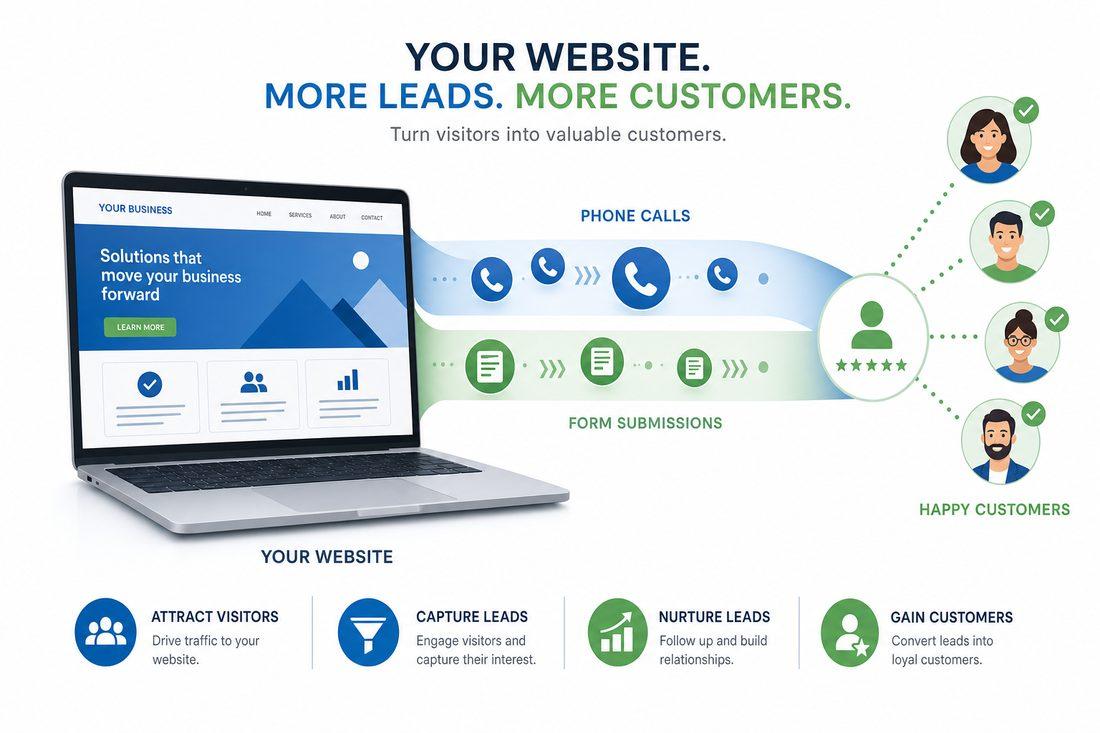
Nobody wakes up in the morning thinking, I really need a new website.
What they’re actually thinking is: Why isn’t my phone ringing? Why are people finding me and not calling? How is that other company getting all the leads when I know we do better work?
The website is just the tool. The outcome is what matters — more calls, more booked jobs, more customers who found you on Google and chose you over everyone else.
When you understand that distinction, everything about how you approach your website changes.
The Digital Business Card Problem
A lot of local business websites are beautiful. Professionally designed. Nice fonts. Great photos. And completely inert.
They exist the way a business card in a drawer exists — technically “there,” but not doing any work.
The business card mindset goes like this: I need something to show people that I’m a real business. A place to list my services and put my phone number.
That’s not wrong. But it’s not enough. Not even close.
A website built as a digital business card looks professional but doesn’t guide anyone anywhere. Visitors land on it, look around, aren’t sure what to do, and leave. No call. No form fill. No lead.
The website looked fine. The outcome was zero.
Treating Your Website Like a Sales Asset
Here’s the shift that changes everything: your website is not an art project and it’s not a brochure. It’s a sales asset. A conversion tool. The first member of your sales team — available 24 hours a day, working while you’re on a job, answering questions at 11 pm when no one is in the office.
When you treat it like a sales asset, you start asking different questions:
- Not: “Does this look nice?” — but: “Does this make someone want to call?”
- Not: “Did we include all our services?” — but: “Is it clear what we do and who it’s for?”
- Not: “Does the homepage tell our story?” — but: “Does the homepage guide someone toward the next step?”
The difference between a website that generates leads and one that doesn’t usually isn’t the design. It’s the intent behind the design.
What a High-Performing Website Actually Focuses On
If your site is going to produce the outcome you want — calls, leads, booked jobs — it needs to do four things well.
Clear Positioning
Within seconds of landing on your site, a visitor should know: who you help, what you do, and where you operate. “your local area’s trusted landscaping company for residential and commercial properties” says everything. “Welcome to our website” says nothing.
Your positioning statement is the single most important line on your homepage. If it’s vague, generic, or buried — everything else suffers.
Social Proof
People don’t take your word for it anymore. They take other customers’ word for it. Reviews, testimonials, years in business, number of jobs completed — proof that others have trusted you and been happy.
This isn’t vanity. It’s one of the most powerful conversion elements on any page. Put it close to your calls to action, not buried at the bottom.
Frictionless Action
Every element of your site should make it easier to take the next step. A big, clear phone number at the top. A contact form that takes less than a minute to fill out. A “Call Now” button that works with one tap on mobile. One consistent CTA repeated throughout the page.
The harder it is to contact you, the fewer people will. This isn’t about design — it’s about removing every possible obstacle between a visitor and a conversation.
Speed and Mobile Usability
None of the above matters if your site loads slowly or falls apart on a phone. Most of your potential customers in your community are finding you on their phones, probably in the middle of their day. If that experience is frustrating, they’re gone.
Google has used mobile-first indexing since July 2024, meaning the mobile version of your site is the version that determines your Google ranking. Fast and mobile-friendly isn’t optional — it’s the baseline.
The Real Question to Ask About Your Website
Instead of asking “Does my website look good?” — ask this:
If 100 people visited my site today, how many would call or fill out the form?
For most small business websites, the honest answer is somewhere between 1 and 5. A well-optimized site can move that number significantly higher. That’s not a minor improvement — it’s the difference between a struggling phone and a busy one.
You don’t need to rebuild your whole site from scratch. You need to be honest about what it’s doing and what it’s not.
Quick Takeaways
- Business owners don’t need a website — they need calls, leads, and booked jobs
- A “digital business card” mindset produces a site that looks fine but converts nothing
- Treat your website as a sales asset: it should guide visitors toward taking action
- Four pillars of a high-performing site: clear positioning, social proof, frictionless action, speed and mobile usability
- The question isn’t “does it look good?” — it’s “does it generate calls?”
FAQ: Getting Real Results from Your Business Website
My website has been up for years. Why isn’t it generating calls?
Most sites are built once and left alone. But a website that doesn’t actively guide visitors toward action — with clear messaging, social proof, and a visible CTA — doesn’t convert regardless of how long it’s been live. A conversion audit can identify exactly what’s in the way.
What’s the difference between a website that looks good and one that generates leads?
Design gets people to stay. Structure and intent get them to act. A beautiful site with confusing navigation, a buried phone number, and no clear CTA will lose to a simpler site that makes it obvious what to do next.
Do I need to rebuild my whole site or can I fix what I have?
Often, significant improvements can come from targeted changes: rewriting the headline, adding proof near the CTA, shortening the contact form, making the phone number clickable, improving load speed. A proper audit will tell you whether a tune-up or a rebuild makes more sense.
How do I know if my website is actually generating leads?
Set up Google Analytics or a similar tool to track form submissions, phone number clicks, and page behavior. If you don’t have that in place, you’re flying blind. You should know exactly where your leads come from.
Your Website Should Be Earning Its Keep
If your site is sitting there looking nice but not generating calls — it’s not working for you. That’s a fixable problem. At Medic 1 Media, we work with your community service businesses to turn their websites from passive brochures into active lead-generation tools. We look at your messaging, your structure, your mobile experience, and your conversion path — and we build something that actually delivers the outcome you’re after. It starts with a free, no-pressure website audit. [Claim your free website audit from Medic 1 Media →] Your website should be your hardest-working employee. Let’s make sure it is.
Get My Free Growth Audit