Websites & Conversion
Why Separate Service Pages Win More Local Customers
One ‘Services’ page isn’t enough for local businesses. Individual service pages rank better on Google and convert visitors into customers far more effectively.
·5 min read
Imagine walking up to a building with 20 different signs on the front door. Roof repairs. HVAC service. Pest control. Gutter cleaning. Tree removal. All stacked on top of each other.
Would you feel confident walking in? Or would you wonder if any of them do great work at any single thing?
That’s exactly what a single “Services” page feels like to a visitor — and to Google.
One page trying to cover everything ends up doing justice to nothing. And in a market like your local area where local competition is real, that matters.
What Most Business Websites Get Wrong
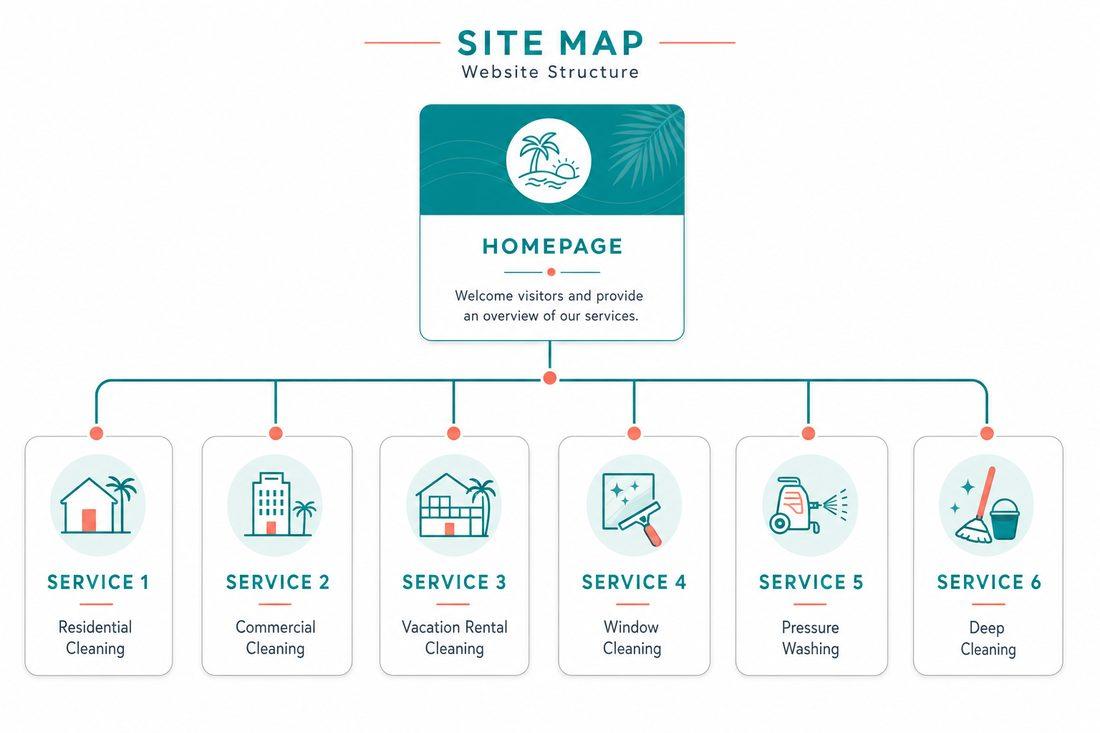
The typical small business website has a navigation menu that looks something like this: Home | About | Services | Contact.
The Services page lists everything the company does — sometimes in bullet points, sometimes in short paragraphs — and then has one CTA at the bottom. Done.
The problem? That approach makes life harder for both your potential customers and the search engines trying to match your business to people who need you.
Here’s why it falls short:
- For Google: A single page covering 10 services sends mixed signals. Google doesn’t know which service to rank you for, so it often ranks you for none of them particularly well.
- For the visitor: Someone who needs tree removal doesn’t care about your pest control service. When everything is crammed onto one page, they have to work to find the information relevant to them — and most people won’t bother.
- For conversions: A general page with no specific CTA for a specific need converts far worse than a focused page that speaks directly to one customer’s problem.
The Case for One Page Per Service
When you give each service its own dedicated page, the whole dynamic changes.
Google Can Actually Understand You
Search engines work best when a page has a clear, singular focus. A page dedicated entirely to “residential lawn maintenance in your area” tells Google exactly what it’s about. It can include the right keywords naturally, answer specific questions about that service, and build relevance around a single topic.
The result? You stand a much better chance of showing up when someone searches for that specific service in your area. And local searches with high intent — someone actively looking to hire — are exactly the ones you want to capture.
Visitors Get Answers Faster
When someone clicks through to a page about the specific thing they need, they immediately know they’re in the right place. The page speaks to their situation, answers their questions, and guides them toward the next step — without making them scroll past six other services they don’t care about.
That relevance builds trust fast. It signals: we do this, and we do it well.
Each Page Can Have Its Own Focused CTA
A tree service page can say “Request a Free Tree Assessment.” A lawn care page can say “Get a Custom Lawn Maintenance Quote.” An accounting page can say “Schedule a Free 30-Minute Consultation.”
Specific offers tied to specific services convert better than generic “Contact Us” buttons at the bottom of a page that covers everything. The visitor feels understood, not shuffled through a process.
What a Strong Service Page Includes
Not all service pages are created equal. Here’s what makes one actually work:
A Clear Headline That Names the Service and Location
“Tree Removal and Trimming in your area, FL” does the job for both the visitor and Google. It’s specific, it’s local, and it immediately confirms they’re in the right place.
A Description That Speaks to Benefits, Not Just Features
Don’t just list what you do — explain what the customer gets. Not “we provide residential lawn maintenance” but “your lawn stays healthy, neat, and properly treated through every Florida season without you lifting a finger.”
Proof
A few reviews from customers who used that specific service. Photos of completed work. How long you’ve been doing this. Social proof that’s relevant to this particular service makes a real difference.
A Service-Specific FAQ
What questions do people ask before booking this service? Answer them right on the page. Pricing ranges. Timing. What to expect. This reduces hesitation and pre-qualifies the people who reach out.
A Clear, Service-Specific CTA
One strong call to action, tied to the service, placed near the top and repeated near the bottom.
Local Signals
Naturally mention your area, your county, and nearby areas you serve. Don’t force it — work it in where it makes sense. It helps both human readers and search engines understand where you operate.
How Many Service Pages Do You Need?
A good starting point: one page for each of your 4–6 core services. If you serve distinct geographic areas, you may also consider location-specific pages down the road.
Don’t try to create 20 pages overnight. Start with your top revenue-drivers — the services most people hire you for — and build from there. Each page is a new opportunity to rank, convert, and demonstrate expertise.
Quick Takeaways
- One general “Services” page spreads attention and ranks poorly for specific searches
- Individual service pages give Google a clear signal and help you rank for specific, high-intent searches
- Focused pages convert better because visitors land exactly where they need to be
- Each page should include a clear headline, benefit-focused description, proof, service-specific FAQ, and CTA
- Start with your 4–6 most important services and build outward from there
FAQ: Individual Service Pages for local Businesses
How is having separate service pages different from one Services page?
A single Services page is generic — it covers everything but ranks for nothing specific. Individual pages let you go deep on each service: targeted keywords, detailed information, specific CTAs. Google rewards relevance, and so do customers.
Will having more pages hurt my website?
Not at all — as long as each page has real, useful content (which it should). More focused pages typically means more opportunities to rank in Google searches and more chances to convert different types of visitors.
How long should each service page be?
Long enough to thoroughly answer a visitor’s questions about that service — typically at least 400–600 words. Include a description of the service, who it’s for, what the process looks like, pricing context, and a FAQ. Quality and relevance matter more than hitting a specific word count.
Should I add the city name to every service page?
Yes, naturally. “Lawn Care in your area, FL” in the headline and naturally throughout the page tells Google you’re local and relevant for local searches. Just don’t force it — write for humans first, search engines second.
Build a Site That Works as Hard as You Do
If your website is still working off a single Services page, you’re leaving rankings and leads on the table. The fix is straightforward — but it needs to be done right to get the results. At Medic 1 Media, we build service-specific pages for local businesses that are designed to rank on Google and convert visitors into calls. Each page functions as its own mini sales page — clear, specific, and built around the customer’s needs. Want to see what that would look like for your business? Start with a free website audit. [Get your free website audit from Medic 1 Media →] One conversation could mean a lot more calls.
Get My Free Growth Audit