Websites & Conversion
Branded Email and Trust Signals: Stop Leaking Credibility Online
If your business email ends in @gmail.com, you’re losing trust before you say a word. Learn the trust signals that matter most for local businesses.
·6 min read
Imagine a plumber shows up to your house. He’s wearing a clean company uniform, driving a marked van, and hands you a business card with a real address on it.
Now imagine a different plumber shows up. He’s in a random T-shirt, driving an unmarked car, and gives you a handwritten note with his first name and a Gmail address.
Who do you trust instinctively? Who do you hesitate on?
The service might be identical. The skills might even be identical. But the signals tell a completely different story — and that story determines whether you hand over the keys.
Your website works exactly the same way.
First Impressions Happen in Milliseconds
The Stanford Web Credibility Project has studied what makes people trust — or distrust — websites for decades. Their findings are clear: people judge a site’s credibility very quickly, and visual design is one of the first and most powerful factors they use.
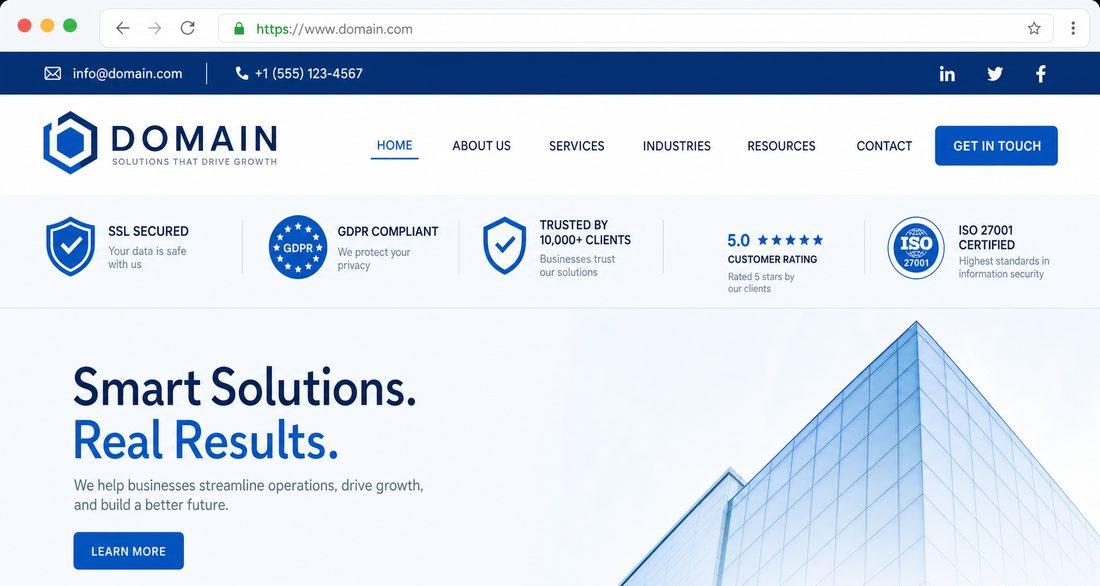
Professional appearance, consistent branding, easy-to-find contact information, and technical markers like HTTPS all shape how legitimate your business appears — often before someone has read a single word of your content.
That’s not superficial. That’s psychology. Humans are wired to make fast trust assessments based on available signals, and your website gives them dozens of signals in the first few seconds.
The question is: are those signals working for you or against you?
The Trust Signals That Matter Most for Local Businesses
Branded Email: The First One to Fix
If your business email ends in @gmail.com, @yahoo.com, or @hotmail.com, you’re broadcasting something you probably don’t intend to broadcast: “I’m not quite serious about this yet.”
That might feel harsh, but it’s the subconscious read many people have. A Gmail address suggests a side hustle, not an established business. It’s the digital equivalent of showing up without a uniform.
A branded email — you@yourbusiness.com — is a basic trust signal. It tells customers you own your domain, you’ve invested in your business infrastructure, and you’re operating at a professional level. It costs almost nothing to set up and it changes the perception immediately.
HTTPS: The Lock Icon That Matters
When someone visits your website and the browser shows a little padlock in the address bar, that’s your HTTPS certificate at work. When it’s missing — or worse, when the browser flags your site as “Not Secure” — you’ve just introduced doubt at exactly the wrong moment.
Most visitors won’t consciously know what that warning means. But they’ll feel it. A sense of unease, a hesitation, an instinct to back out. You can lose a call over a missing SSL certificate.
This is a small technical fix with a disproportionate impact on trust.
Consistent Branding Across Every Touchpoint
Consistency signals intentionality. When your website colors, logo, fonts, and tone all match — and match your social profiles, your emails, and your business cards — the message is: this operation is put together.
Mismatched branding (old logo on the website, different colors on Facebook, a completely different vibe on Google Business Profile) creates subtle friction. It makes people wonder if the business is organized, professional, or even the same entity.
You don’t need a fancy brand identity system. You need the basics to be consistent: the same logo, the same primary color or two, the same name format, the same contact information everywhere.
Professional Typography and Clean Layout
As the Stanford Web Credibility research highlights, visual design quality is a core factor in how people assess website legitimacy. Poor typography — inconsistent font sizes, hard-to-read colors, or clashing styles — registers as unprofessional even to people who couldn’t articulate why.
Clean, readable fonts. Adequate spacing. A logical hierarchy of text sizes. These aren’t luxury design choices; they’re baseline credibility.
Easy-to-Find Contact Information
Nothing signals “we’re a real business” more clearly than a phone number and address that are easy to find. Front page, easy to spot, clickable on mobile.
When contact information is buried — or worse, absent — the trust alarm goes off. Why are they hiding? Are they even a real company? Do they not want to be reached?
For local businesses especially, being findable is a feature. Your community is looking for someone local. Make it effortless for them to confirm you’re real, you’re close, and you’re reachable.
Recent Content and Active Updates
A website that hasn’t been updated in years — with blog posts from 2019, copyright footers reading “© 2021,” or outdated service offerings — signals neglect. And if the website looks neglected, the business might be too.
This doesn’t mean you need to blog constantly. But keeping the basics current (correct phone number, updated services, accurate hours, a recent Google review or two embedded) signals that someone’s paying attention.
These Are Not Nice-to-Haves
That’s the mindset shift worth making here. Branded email, HTTPS, clean branding, professional layout, easy contact info — these aren’t premium upgrades for businesses that have “made it.”
They’re the baseline standard that local customers in 2024 expect before they trust you enough to call. Every one that’s missing is a small leak in your credibility bucket. Small leaks add up.
Quick Takeaways
- Customers judge your website’s trustworthiness in seconds — often before reading a word.
- A branded email (you@yourdomain.com) signals professional legitimacy; a Gmail address undermines it.
- HTTPS (the lock icon) is a basic technical trust signal — missing it creates doubt.
- Consistent branding across all touchpoints signals an organized, credible operation.
- Easy-to-find contact information is non-negotiable for local service businesses.
- Outdated content signals neglect; keeping basics current signals you’re active and reliable.
FAQ
Why does it matter if I use a Gmail address for my business?
It matters because customers make quick trust judgments based on small signals. A Gmail address suggests a side project or a brand-new operation, not an established local business. A branded email costs little to set up and immediately upgrades how professional you appear.
How do I get a branded email address?
Your domain registrar or web hosting provider typically offers business email as part of their packages — or you can use Google Workspace or Microsoft 365 to get a professional email linked to your domain. Your web developer or digital marketing team can set this up quickly.
What is HTTPS and why does it matter for my website?
HTTPS encrypts the connection between your visitor’s browser and your website, indicated by the padlock icon. Browsers now actively warn users when a site lacks it. Even if your site doesn’t collect sensitive data, the “Not Secure” warning erodes trust immediately.
Does my website’s visual design really affect whether people trust me?
Yes — and research backs this up. The Stanford Web Credibility Project found that visual design is one of the primary factors people use to assess a website’s legitimacy. Professional layout and typography aren’t just aesthetics; they’re trust infrastructure.
Let’s Make Sure Your Site Is Sending the Right Signals
Trust signals are often the quiet reason a visitor calls you — or doesn’t. They’re working in the background on every single visit. At Medic 1 Media in your area, we review the full picture: branded email, HTTPS, branding consistency, layout, and all the other credibility markers that determine whether your site builds trust or quietly erodes it. We offer a free website audit where we’ll walk you through exactly what your site is communicating — and how to make sure every signal says “established, professional, trustworthy.”
Get My Free Growth Audit